Portfolio
Featured Artists
Meet the artists behind the collection — a growing roster of Nigerian painters whose work spans landscape, portraiture, and abstraction.
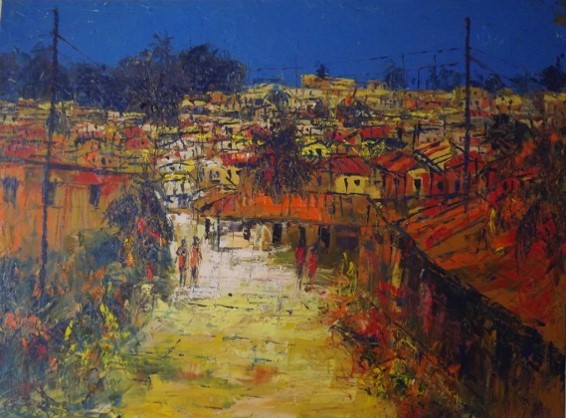
Akhile Ehiforia
Nigerian, born 1975
Akhile Ehiforia is among the new generation of Nigerian artists whose works have continued to divert attention away from mainstream themes of artistic representation, with an increasing focus on minimal pictorial imagery associated with rural life — mostly a dense arrangement of trees spread upon breath-taking landscapes, retaining a constant nostalgic image that unites the artist to its root. Born in 1975 in the ancient city of Benin, Ehiforia’s native environment is reputed for its natural ambiance, especially for the woods and groves scattered around its towns.
When he painted “A Road Not Taken” in 2011 — a piece with an encrusted surface, simulating a tree bark while depicting a landscape covered with trees in earthy and partly yellow hues, with soft sunlight pouring from within the branches as though a weak smog gutters — viewers concluded that the work was inspired by the poem of the same title by the American poet Robert Frost (1874–1963).
Even though Ehiforia's roofscape series of paintings reveals a personal fascination with the curious architecture of rural Lagos, where he now lives and works, they also reference the architectural background of his native town, where mound houses sit atop each other and rusty zinc sheets are layered like flat light metal, giving the entire scenery the effect of a growing mass of beautiful ruins.
Ehiforia studied painting at Auchi Polytechnic in Edo State from 2002–2005, where he graduated with both an Ordinary National Diploma (OND) and a Higher National Diploma (HND) — time that most likely afforded him the leisure to observe, with serious attention, the geographical layout and nature of his environment.
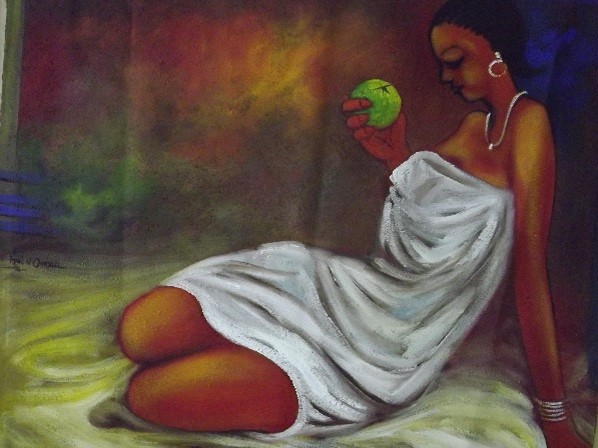
Fidel Nnamdi Oyiogu
Nigerian, born 1957
The works of Fidel Oyiogu are characterized by a design quality that reemphasizes the claim to the aesthetic function of art. Whilst a cartoonist with Champion Newspaper in the 1980s, he featured in four group exhibitions, including one at the African Art Gallery, Germany, and the Goethe Institute, Lagos. These shows drew public attention especially to his arresting feminine forms, submerged in an eclectic display of movement in relation to rhythm and carefully rendered with rare monochromes that retain a lofty density of aquamarine, red, and yellow hues.
The artist's interest in aesthetic elements is reflected in his appropriation of forms and geometric images associated with the shrine mural paintings of the Uli tradition in his native region — a concept subjected to innovative phases on his canvas.
Oyiogu trained at the Institute of Management and Technology, Enugu, from 1980–1985. Between June and September 2013, he went on an exhibition tour with his recent works in Germany, Austria, and the Netherlands. He currently lives and works in Lagos.
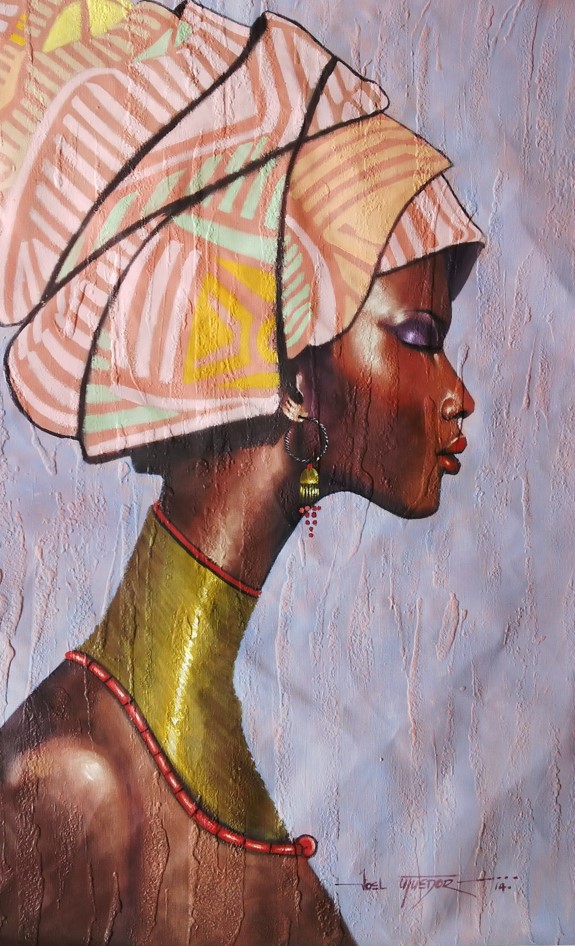
Joel Otuedor
Nigerian, born 1972
Joel Otuedor generated controversy among a group of private collectors in Nigeria with a number of interesting curvaceous nude paintings, referencing the erotic as well as the physiognomy of the female body. These works were sharply criticized by some as voyeuristic, carnal, and obscene, but for Otuedor they were an ongoing representational study on the debate of gender and identity — portraying unclad women on canvas was for him a strategy for mapping his perspective, presenting them through an intimate, private space. In one of the works, “Beauty Room” (2012), Otuedor exaggerated the proportion of his subjects to heighten the sense of connection between the viewer and the painting. Away from nude pieces, some of Otuedor’s realistic life-size portraiture offers a close study of the politics of gender. In 2011, Otuedor was part of 12 Nigerian artists featured in the exhibition “Art by Contemporary Masters”, organized by Tribesart Gallery at Waterfront Restaurant, Lagos.
Joel Otuedor studied Fine Art at Auchi Polytechnic, Edo. He lives in Lagos and works from his home.
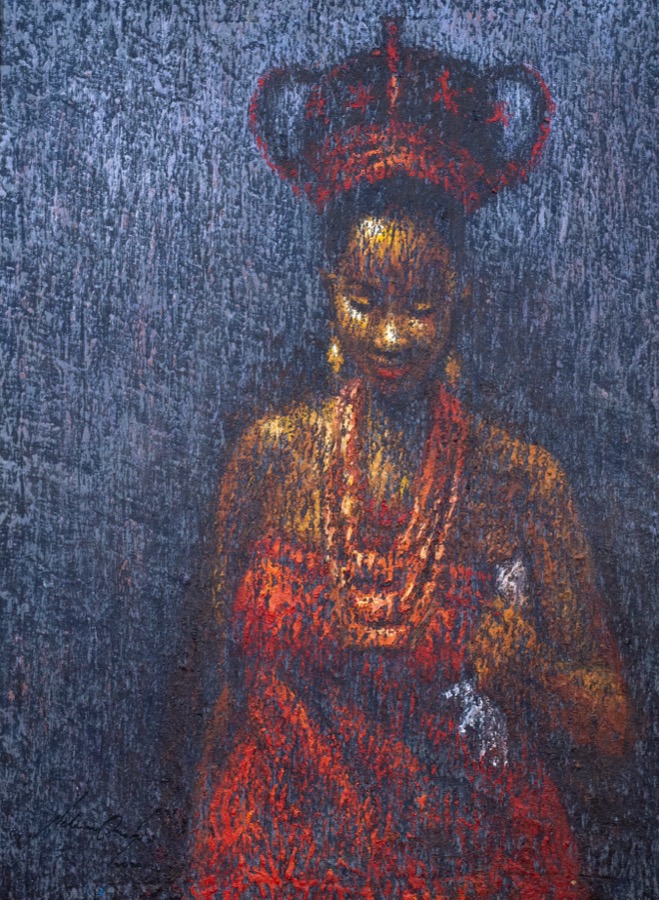
Nelson Okoh
Nigerian, born 1974
Understanding the half-abstract forms in Nelson Okoh's works requires more than a casual glance from a viewer. This is especially so with his portraiture series depicting tranquil women's faces or a quarter-length frame, mostly either in a meditative gaze or freely posing as models. One of his famous paintings, “Yellow Earrings” (2012), can be read through a special conceptual lens: Okoh composes the form of his subject's face in deft brushstrokes and applies yellow for complementary purposes, adding and highlighting the same details for emphasis. The sallow treatment of the lady's lower lip and the pearls of simplified, dorsal-fin-shaped earrings standing out of the composition stress these features, while also helping to balance the spreading fall of light upon the subject's face.
A self-taught artist, Okoh describes his style as impressionism, created through the use of a palette knife. “I am inspired by everything around me (nature in general). Sometimes it could be from the wave of the sea, ripples of water on a surface, colours of the sky, body language,” he said. “I just believe the world is filled with a lot, if we decide to open our eyes to see beyond what is visible to the average person.”
Okey Ibeabuchi
Nigerian, born 1972
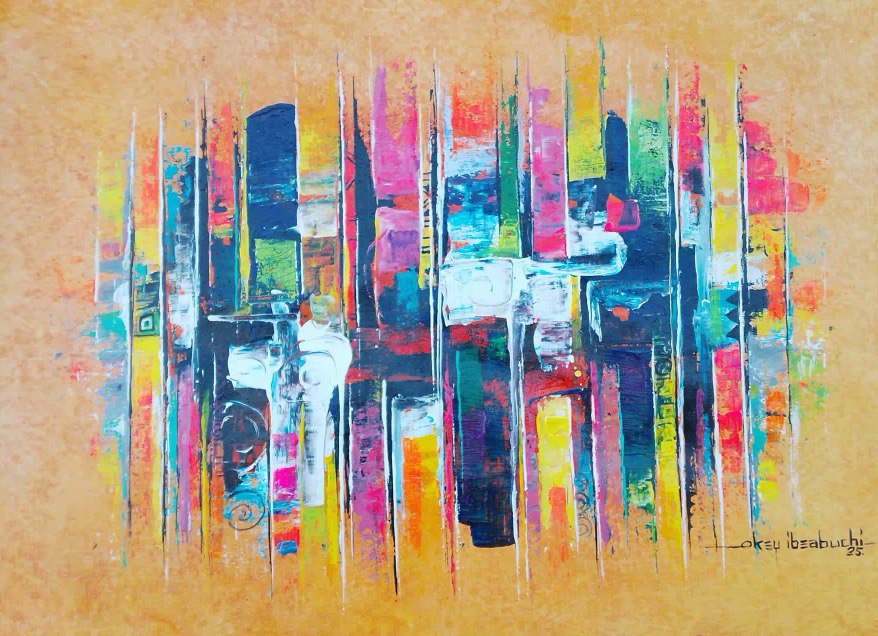
The 2008 group exhibition “Arts & Objects” at the Henri Moweta Gallery, Lagos, displayed works by Okey Ibeabuchi noted for their massive relief surfaces. Perhaps encouraged by an approving response from collectors following his previous shows in Abuja and Lagos, between 2010 and 2012 he produced paintings that were even more tactile — as though the artist were sculpting on canvas with encrusted surfaces built from a complex network of jute, caps from empty colour tubes, cones, plastic bottle covers, found rubber slippers, and decaying wood. From then onward, these largely waste materials became recurring elements in his art. Ibeabuchi’s background as a graphic artist also influences his use of colour: his early paintings, predating his low-relief works, feature an enviable range of luminous colour, while his more synthetic use of colour and divisionist approach draws critical attention to the brilliant pointillism in his works — especially the remarkable, monumental pieces relying on carefully placed tiny dots to create forms of glamorously decorated women.
Bolaji Ogunwo
Nigerian, born 1978
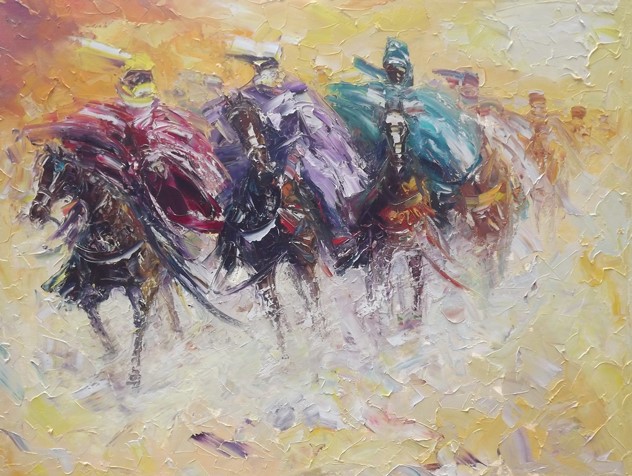
There is a certain luminosity that emanates from Bolaji Ogunwo’s works, revealing a delicately rich application of heavy palette. Ogunwo, who holds a BA in Fine Art from the University of Benin and is currently a PhD research student and painting lecturer in the Department of Creative Arts at the University of Lagos (where he also obtained an MA with honours), describes his art as “finding expression in impressionism”. Five years after graduation, from 2006–2010, the paintings Ogunwo produced reveal a significant shift in their thematic preoccupation: many re-capture scenes of Maroko’s mangrove swamps, log houses and cubicles reinforced by zinc sheeting and cardboard, and found objects from cannibalized automobiles, sometimes rendered as blurred, cluttered images of a scavengers’ heaven. But this was before 2006.
Ogunwo still makes occasional returns to that range of themes. His strong interest in the diverse cultures within Nigeria has also inspired works based on the fervour of contemporary traditional Yoruba festivals, cutting across royal equestrian displays in the north of the country and the cultural traditions of other regions as well.